

The Court Put Louisiana Landowners Back in the Game. Now the Legislature Must Answer.
A major Louisiana Supreme Court ruling did not end the CCS fight. But it did put landowners back on the field and force hard questions about eminent domain, pressured contracts, and what comes next for HB7.
For over three years, Louisiana citizens have been told the same thing: carbon capture is coming, the land will be taken if necessary, and the people standing in the way are fighting a losing battle.
On March 6, 2026, the Louisiana Supreme Court changed the tone of that fight.
In Plaquemines Port Harbor & Terminal District v. Tuan Nguyen, the court held that a public authority could not expropriate private property simply to lease it to a private company for that company’s exclusive development and use. The court said that kind of taking was not for a valid public purpose under the Louisiana Constitution. It also made clear that economic development, tax revenue, and incidental public benefit are not enough to justify taking private land. (Louisiana Supreme Court)
That matters far beyond Plaquemines Parish.
It matters because, for years, Louisiana landowners have warned that eminent domain has been stretched, twisted, and politically protected in ways that trampled the very constitutional safeguards voters put in place in 2006. In this opinion, the Supreme Court pointed directly back to those 2006 constitutional changes, which were adopted after Kelo, to limit takings for private gain dressed up as public benefit. (Louisiana Supreme Court)
Let’s be clear about what this ruling does and does not do.
It does not stop CCS in Louisiana.
It does not automatically void every easement, option, or pipeline agreement already signed.
It does not instantly erase every law the Legislature has passed to help industry move projects forward.
But it does something politically explosive: it reaffirms that public power has limits, and those limits do not disappear just because the project is big, expensive, or backed by powerful corporations and political allies. (Louisiana Supreme Court)
That puts one unavoidable question back on the table:
What happens to landowner agreements signed under the pressure of eminent domain if that pressure was built on a constitutionally shaky foundation?
That question will not be answered by Facebook commentators or industry talking points. It will be answered in hearings, in lawsuits, in negotiations, and possibly in future courtrooms. Louisiana law says consent can be vitiated by duress when it is obtained through a reasonable fear of unjust and considerable injury to a person, property, or reputation. Louisiana law also says a contract may be relatively null when a party did not give free consent. That does not mean every signed agreement is automatically dead. It does mean some landowners may have serious new reasons to review what they signed, how they signed it, and what threats were hanging over them at the time. (Louisiana Legislature)
That is why HB7 now matters more than ever.
HB7, filed by Rep. Mike Johnson and titled the “Louisiana Landowners Protection Act,” would prohibit expropriation by private entities for transporting carbon dioxide by pipeline or for the geologic storage of carbon dioxide. As introduced, it also targets existing legal authority that has helped build the current CCS land-grab framework. Its referral to House Natural Resources means this constitutional fight is no longer theoretical. It is now before legislators, who will have to decide whether to stand with landowners or with the corporations that want their land. (Louisiana Legislature)
That is where this story turns from good news into marching orders.
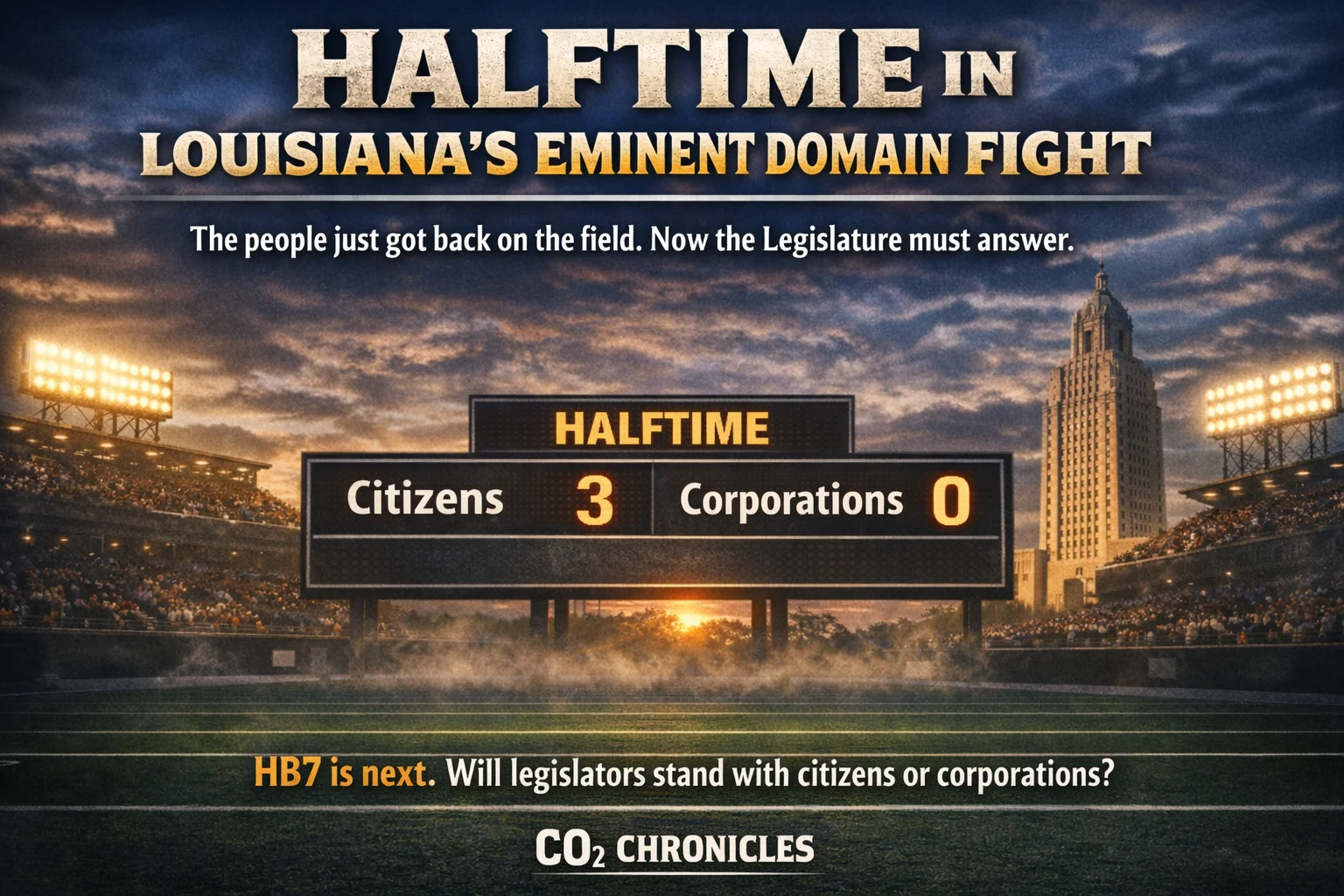
This ruling is not a final victory. It is not the time to spike the ball and go home. It is a three-point score at halftime.
The people of Louisiana have been put back in the game. But getting back in the game and winning the game are two very different things.
Now is the time to get organized.
Now is the time to show up at hearings.
Now is the time to join groups, make calls, contact legislators, and force answers on the record.
Every legislator who claims to support property rights should now be asked the same simple question:
If the Louisiana Supreme Court has reaffirmed that private property cannot be taken for private gain under the disguise of public purpose, why are you still protecting the legal machinery that made those threats possible?
The court has spoken.
Now the Legislature must answer.
CO₂ Chronicles is committed to covering the stories that too many mainstream outlets ignore.
We report on the issues that directly affect Louisiana landowners, families, and communities—without outside influence and without backing down from powerful interests. During the legislative session, we will keep our stories free and open to the public because the people deserve to know what is happening. If you believe this work matters,
please consider donating to help support CO₂ Chronicles and keep independent journalism alive.

