
By Renee’ Savant | CO₂ Chronicles
A Texas company is trying to turn central Louisiana into ground zero for one of the largest carbon dumping grounds in America. CapturePoint, backed by billions in federal subsidies, is racing to establish its “Central Louisiana Regional Carbon Storage Hub” across Vernon and Rapides Parishes — a project that could bury over 2 billion tons of CO₂ beneath our communities.
On paper, it looks like progress: federal 45Q tax credits pay $85 per ton of CO₂ stored, fueling what amounts to a modern-day carbon gold rush. Behind the upbeat press releases, though, locals see something very different: a company showering communities with money, perks, and promises while hiding risks and steamrolling opposition.
As one Vernon Parish resident put it bluntly:
“It’s like they’re in a mad rush for those tax credit dollars, and we’re the guinea pigs.”
Buying Goodwill: Carbon Cash for Schools and Officials
From the very beginning, CapturePoint has flooded Vernon Parish with money. New school programs. Career training initiatives. Sponsorships framed as “investments in the future.” On the surface, it looks like generosity — but to many, it looks like corporate bribery designed to soften resistance.
- School Board Partnership: CapturePoint partnered with Vernon Parish schools and a local labor union to launch its “Capturing Better Futures” program. Slick PR videos painted it as a win-win.
- Mississippi Example: The company paid nearly $10,000 to send a high school sports team to summer camp in a neighboring state where future storage sites are planned.
One parent cut through the spin:
“They think if they throw enough money at our schools, we’ll shut up about the carbon bombs they want to bury under us.”
A Stunning Flip-Flop: What Changed?
The Vernon Parish Police Jury once stood firmly against CO₂ injection. In November 2024, the jury voted to object until impacts were better understood. At that time, Police Jury President Jim Tuck noted no company had offered any real compensation or benefits.
But now, less than a year later, some jurors have gone quiet or even flipped their stance. What changed?
Rumors swirl of a $3 million “funding offer” dangled before the Police Jury. Community watchdogs suspect that CapturePoint’s strategy is simple: fatten school budgets, grease local projects, and eventually bring officials into line.
The Carbon Capture Playbook
What’s happening in Vernon isn’t unique — it’s straight out of the industry’s national strategy.
- Write Checks: Fund schools, youth sports, or civic projects.
- Control the Narrative: Fill local media with glowing coverage while dismissing critics as “fearmongers.”
- Divide & Conquer: Reward certain landowners with lease deals, creating a pro-project faction.
- Dangle Big Promises: Jobs and “community development funds” for those who play ball.
CapturePoint boasts that communities with projects are “glad they have them, and communities without projects wish they did.” But in Vernon Parish, many see it for what it is: manipulation dressed up as charity.
The Question That Won’t Go Away
Why are local officials enabling a project so many residents don’t want? At town halls and on Facebook forums, the same questions echo:
- What did our leaders promise CapturePoint behind closed doors?
- Who benefits when our parish becomes a carbon dumping ground?
The more the money flows, the more those questions grow louder.
Part 1 showed how Capture Point floods parishes with cash to buy influence. But the real danger lies in what they’re hiding. In Part 2, CO₂ Chronicles uncovers the story they don’t want you to see:
- Redacted Safety Plans: Entire sections of CapturePoint’s emergency response strategy are blacked out. If a pipeline ruptures or a well blows, the public won’t know what to do — because the company won’t let us read the plan.
- CO₂ Leak Disasters: From Satartia, Mississippi (2020), where cars stalled and children collapsed, to Sulphur, Louisiana (2023), where families were told of a leak by social media instead of alarms — the risks are very real, and they are being repeated.
- Corporate Web of Collaborators: CapturePoint isn’t acting alone. They’ve quietly partnered with major oil & gas players to funnel in CO₂ from refineries and gas plants — and in some cases, through front companies and shell entities that make it hard to track who’s really behind the push. We’ll follow the money and expose the hidden hands steering this so-called “carbon storage hub.”
- Community Betrayal: While citizens demand answers, local and state officials have killed bills that would give parishes the right to veto these projects. Behind those decisions? Lobbyists, donations, and promises of “community funds” that never seem to materialize.
“They can say it’s ‘just CO₂’ all day — that doesn’t matter when a pipeline explodes or a well fails.” – Local advocate
🚨 This isn’t just a fight over pipelines — it’s a web of corporations, shell fronts, and politicians working hand-in-hand to turn central Louisiana into a carbon sacrifice zone.
👉 Don’t miss Part 2. Subscribe now for $4.99/month to unlock the full exposé and support independent watchdog journalism they can’t buy off.
Poisoned Promises: The Secret Partners Behind Louisiana’s Carbon Capture Scheme (Part 2)
By Renee’ Savant | CO₂ Chronicles
When CapturePoint stormed into central Louisiana, they promised “better futures” and showered schools with money. But behind the ribbon cuttings lies a murkier reality: hidden collaborators, shell companies, and safety plans so secret the public can’t even read them.
Welcome to the other half of the story.
SunGas and the Pineville Methanol Gambit
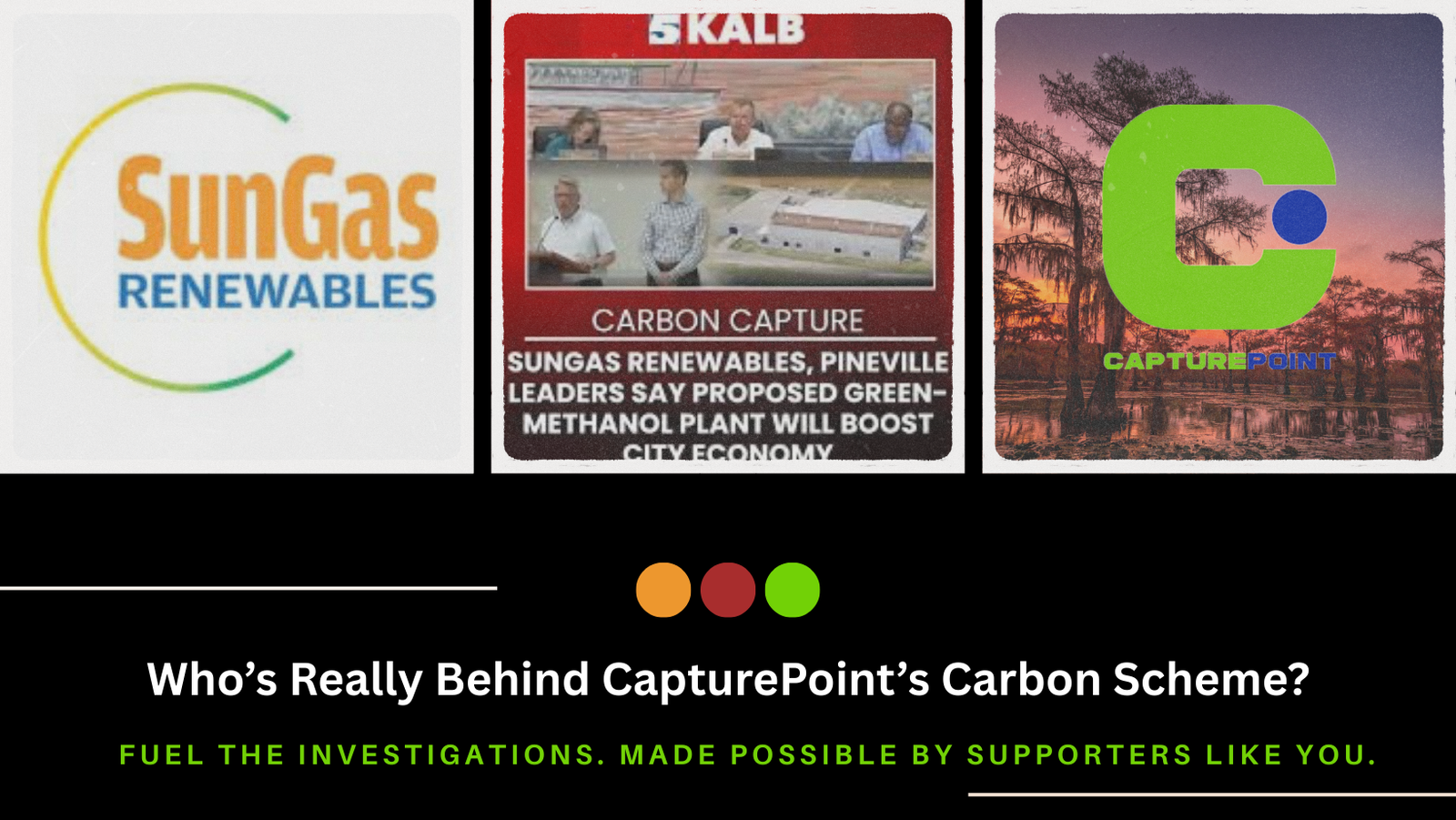
In Rapides Parish, SunGas Renewables is developing a $2 billion Beaver Lake Renewable Energy plant, designed to churn out “green methanol” for shipping giant Maersk and others. On paper, it’s about clean energy. In reality, it’s about capturing and disposing of 1 million tons of CO₂ every year.
Here’s the catch: SunGas hasn’t publicly confirmed where all that carbon will go. But look at the map. Pineville sits squarely in Rapides Parish — the same parish where CapturePoint Solutions, LLC has filed for Class VI injection wells. The overlap is hard to ignore.
Even SunGas’s project website admits Beaver Lake will capture and “permanently remove” massive volumes of CO₂. To do that, they need a storage partner. And in Rapides, CapturePoint is already laying the groundwork.
The public line is “green fuels.” The quiet reality is burying carbon under central Louisiana with no public vote, no transparent safety plan, and no guarantee of protection for aquifers that thousands rely on.
Energy Transfer, Southwestern Energy, and the Pipeline Web
CapturePoint isn’t alone. It has struck deals with some of the biggest players in America’s oil and gas patch.
- Energy Transfer — one of the nation’s largest pipeline operators — signed an agreement with CapturePoint that includes not only CO₂ transport, but also options to co-own the storage hub itself.
- Southwestern Energy, a Haynesville Shale giant, is dedicating its captured CO₂ to the hub. How will it get there? Through Energy Transfer’s pipelines.
- Together, this triangle ensures carbon from Texas and north Louisiana will funnel into Rapides and Vernon.
It’s a corporate pipeline machine — CapturePoint gets the land, Energy Transfer lays the pipes, and Southwestern provides the gas stream. The locals? They’re just expected to host the waste.
The “Shell Company” Maze
To make accountability even harder, the key players operate through LLCs and project subsidiaries that look clean on paper but obscure who’s really responsible.
- Beaver Lake Renewable Energy, LLC (BLRE) — the SunGas project company for the Pineville methanol plant.
- CapturePoint Solutions, LLC (CPS) — the CapturePoint affiliate filing permits in Rapides and Vernon.
- Other subsidiaries exist solely to sign contracts and lease land, insulating parent companies from liability if disaster strikes.
This is corporate sleight of hand: profits flow up to parent firms and investors, but responsibility gets stuck in a limited-liability shell that can be dissolved or bankrupted if things go wrong.
If a CO₂ well fails or a pipeline ruptures, who pays? The LLC with no assets? Or the families left with poisoned water and toxic air?
Black Ink and Red Flags
Residents who tried to review CapturePoint’s permit applications were greeted with something chilling: page after page of redactions.
The company labeled critical sections of its Corrective Action Plan — what to do in case of a leak or blowout — as “confidential business information.” The public can’t see them. Even parish leaders can’t see them. Only the company and regulators know the details.
“This is their safety plan,” one attendee said at a public forum, holding up a document blacked out like a CIA file. “How are we supposed to trust a plan we can’t even read?”
Meanwhile, independent scientists warn that even “pure CO₂” is not harmless. Underground, it forms carbonic acid, which corrodes steel and rock. Pipelines under extreme pressure can rupture “like a zipper.” And when CO₂ floods the air, it suffocates silently — heavier than oxygen, invisible, and odorless.
The Proof in the Leaks
For those who say “it can’t happen here,” the record is clear: it already has.
- Satartia, Mississippi (2020): A CO₂ pipeline rupture hospitalized dozens, stalled vehicles, and left children collapsing unconscious as a dense cloud blanketed the town.
- Sulphur, Louisiana (2023): An Exxon/Denbury pipeline leaked CO₂, forcing residents to shelter in place. One survivor later said: “There should have been alarms… I don’t trust the system we have at all.”
These aren’t hypotheticals. They’re previews of what happens when CO₂ escapes — and they’re happening in the very states now being targeted for massive storage hubs.
A Community Without Consent
Perhaps most disturbing, Louisiana lawmakers just killed a bill that would have given parishes veto power over CO₂ wells. Citizens begged for the right to say yes or no. Industry lobbyists said no — and won.
Rapides and Vernon face the prospect of being locked into hosting billions of tons of carbon waste without consent. CapturePoint, SunGas, and their partners can keep drilling, piping, and injecting — while communities are left to live with the consequences.
Standing Together
CO₂ Chronicles is not alone in this fight. Across Louisiana, grassroots organizers, parish leaders, legal advocates, scientists, and everyday citizens are working side by side to expose the truth about carbon capture and defend our communities.
We are proud to stand in partnership with groups like the Louisiana CO₂ Alliance, Save My Louisiana, the CCS Caucus PAC, and local parish watchdogs who refuse to be silenced. Together, we form a shield of resistance — a coalition that combines investigation, legal action, political pressure, and community organizing.
Because when corporations, lobbyists, and politicians close ranks against the people, the only way forward is through collaboration, solidarity, and relentless truth-telling.
This exposé is just one piece of a larger movement. With your support, we will continue to shine light into the shadows, hold leaders accountable, and make sure Louisiana’s future is shaped by its people — not by profit-driven outsiders.
✊ Join us. Partner with us. Stand with us. Our communities are stronger together.
The industry spends millions to control the message. Your subscription keeps CO₂ Chronicles free from their influence and fearless in exposing the truth in Baton Rouge and beyond.
Subscribe to CO₂ Chronicles

