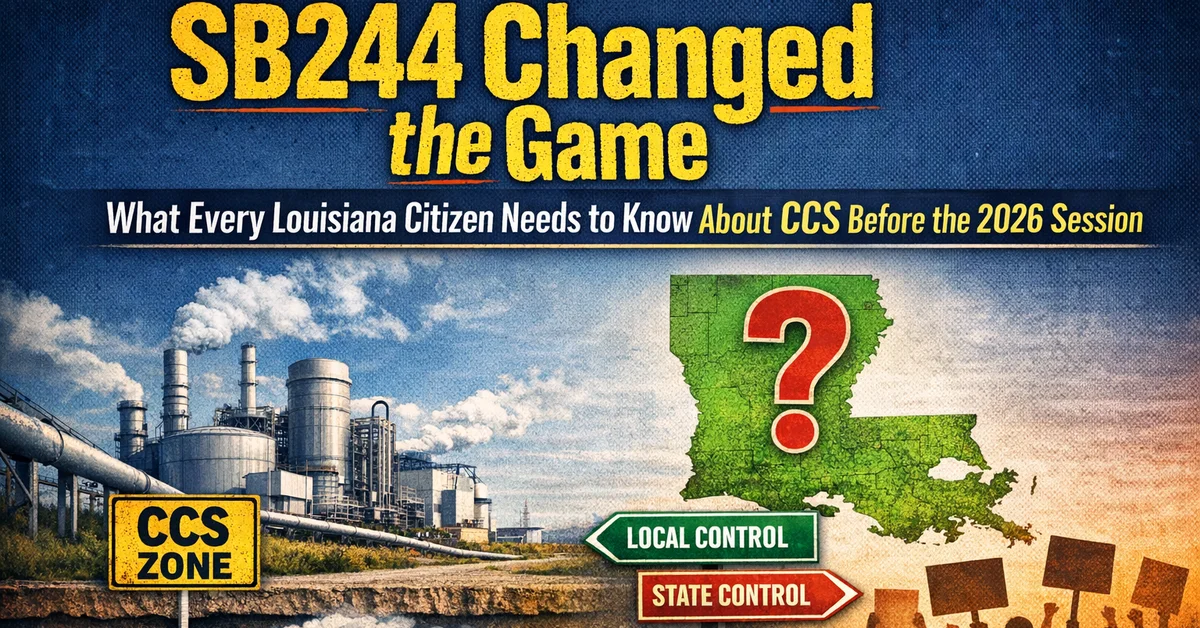


SB244 Changed the Game: What Every Louisiana Citizen Needs to Know About CCS For the 2026 Session
A lot changed in Louisiana in just one year.
Twelve months ago, carbon capture and sequestration was still something many citizens were only beginning to hear about. Today, it is no longer a theory, a rumor, or a future possibility. It is being built into Louisiana law, Louisiana permitting, and Louisiana infrastructure. The single biggest turning point was SB244, which was signed into law in June 2025 as Act 458, with most of its changes taking effect on October 1, 2025.
That matters because SB244 did not slow carbon sequestration in Louisiana. It helped formalize how the state would manage it.
What changed in Louisiana over the last year?
Louisiana moved from promoting CCS politically to strengthening the legal and administrative structure needed to carry it out. In 2025, lawmakers passed major carbon sequestration legislation, including Act 458 (SB244) and Act 414 (SB73). Act 414 raised the percentage of consenting ownership needed for unitization from 75% to 85%, but it did not eliminate the broader sequestration framework. It still preserved a path for projects to move forward under state law. Another law, Act 508 (HB548), created a revenue-sharing structure that sends 30% of certain injection-based revenue from sequestration on state property to the affected parish or parishes.
At the same time, projects kept moving. Louisiana’s own Class VI permitting page shows that Hackberry Carbon Sequestration in Cameron Parish received a final permitting decision, while other applications remain in the pipeline. ExxonMobil also announced that it had begun commercial CCS operations in Louisiana through its CF Industries project, showing that CCS in this state is no longer just about permits on paper. It is becoming operational reality. (denr.louisiana.gov)
So what did SB244 really do?
SB244 changed the power structure.
The law preserved Louisiana’s state-centered control over carbon sequestration projects. It kept the state in the driver’s seat on certificates, permits, and project approvals, even where local resistance exists. It also kept alive the legal framework that allows carbon dioxide transport and storage projects to qualify for state approval under a “public interest” standard. While the law added notice provisions and hearing requirements, it did not hand parishes final veto power over CCS projects.
That is the part citizens need to understand clearly: a public hearing is not the same thing as public control.
SB244 may have improved the process in a few places, but it did not fundamentally shift power back to landowners or parish governments. In practice, it confirmed that Louisiana intends to keep making these decisions largely from the top down.
Why does that matter so much?
Because once the state builds the framework, projects move faster.
Citizens are no longer only fighting a proposal here or a permit there. They are now fighting a system that is being shaped to normalize CCS as part of Louisiana’s future. That means more applications, more pressure on parishes, more pipeline battles, more conflict over land rights, and more arguments over who carries the long-term risk. The law Louisiana passed in 2025 did not end the debate. It moved the debate into a more dangerous phase: implementation.
What should citizens know heading into the 2026 Legislative Session?
The 2026 Regular Session opened March 9, 2026, and the bills already filed show that this session is shaping up to be a direct fight over local control, eminent domain, consent, and liability.
Several of the 2026 bills aim to reverse or limit the direction Louisiana took in 2025.
HB7 would prohibit expropriation by private entities for transporting carbon dioxide by pipeline or for geologic storage of carbon dioxide. That is a direct strike at one of the biggest fears landowners have had all along: the use of eminent domain for CCS projects.
HB327 would declare carbon dioxide sequestration beneath private property illegal without the property owner’s consent, unless the owner cannot be located after a reasonable search and good-faith effort. That bill goes straight to the heart of the landowner-rights fight.
SB61 would allow parish governing authorities and parish voters to determine whether Class VI wells, carbon dioxide sequestration, and CO2 pipelines are permitted within a parish. That is one of the strongest local-control proposals filed so far.
Taken together, those bills show what this session is really about.
What is at stake in 2026?
This session is not just about one permit or one parish.
It is about whether Louisiana will continue down a path where the state makes the key decisions and citizens are left to react after the machinery is already in motion, or whether lawmakers will restore real authority to landowners and local communities.
Here is what is at stake:
1. Local control
Will parishes have the ability to say no to Class VI wells, sequestration sites, and CO2 pipelines, or will Baton Rouge continue making those calls?
2. Property rights
Will private companies continue to have legal pathways that support forced access, expropriation, or pressure-based project assembly, or will lawmakers draw a hard line in favor of landowner consent?
3. The pace of buildout
If the state keeps its current model, more projects can keep moving through the pipeline. If citizens win stronger protections this session, that pace could slow dramatically. (denr.louisiana.gov)
4. Long-term risk
Who is left holding the bag if projects fail, leak, migrate, damage groundwater, or create future legal and financial burdens? That question is still not settled in a way that gives many citizens confidence.
The bottom line
SB244 changed the landscape because it helped move Louisiana from the sales pitch stage of CCS into the governing stage of CCS.
It told citizens something important: the state is not waiting for broad public comfort before building this system out. It is building first, and leaving citizens to fight over the limits later.
That is why the 2026 Legislative Session matters so much.
This is the session where Louisiana citizens must decide whether they are content with hearings that do not equal control, notice that does not equal consent, and a process that still leaves the final decisions in the hands of the state. Or whether they are ready to demand something stronger: real local authority, real property-rights protections, and real limits on how far CCS can go in Louisiana without the people’s consent.
If citizens do not engage now, they may find that by the time the next permit is posted, the real decisions have already been made.
Now is the time for Louisiana citizens to move from concern to action. Contact your state representative and senator and urge them to support the bills that restore local control, strengthen landowner rights, and stop the forced expansion of CCS in our parishes. Ask them to stand with the people on measures like HB7, HB327, and SB61, and to reject any effort that weakens consent, expands eminent domain, or puts our land and water at greater risk. Then share this information, talk to your neighbors, attend hearings, and stay engaged throughout the 2026 Legislative Session. If citizens do not speak now, industry will keep speaking for us.
Follow the C02 Chronicles for up to date information on all CCS bills and stories throughout the 2026 Legislative Session.

