

What Is Carbon Capture and Storage (CCS) in Louisiana?
Carbon Capture and Storage—commonly referred to as CCS—has become one of the most debated and misunderstood industrial programs underway in Louisiana today. Supporters describe it as a climate solution and an economic opportunity. Critics raise concerns about land rights, long-term liability, public safety, and transparency.
So what exactly is CCS, how is it being implemented in Louisiana, and why has it sparked such intense public opposition?
This explainer provides a clear, plain-language overview of what CCS is, how it works, why Louisiana is central to its expansion, and what residents should understand as projects move forward.
What Is Carbon Capture and Storage (CCS)?
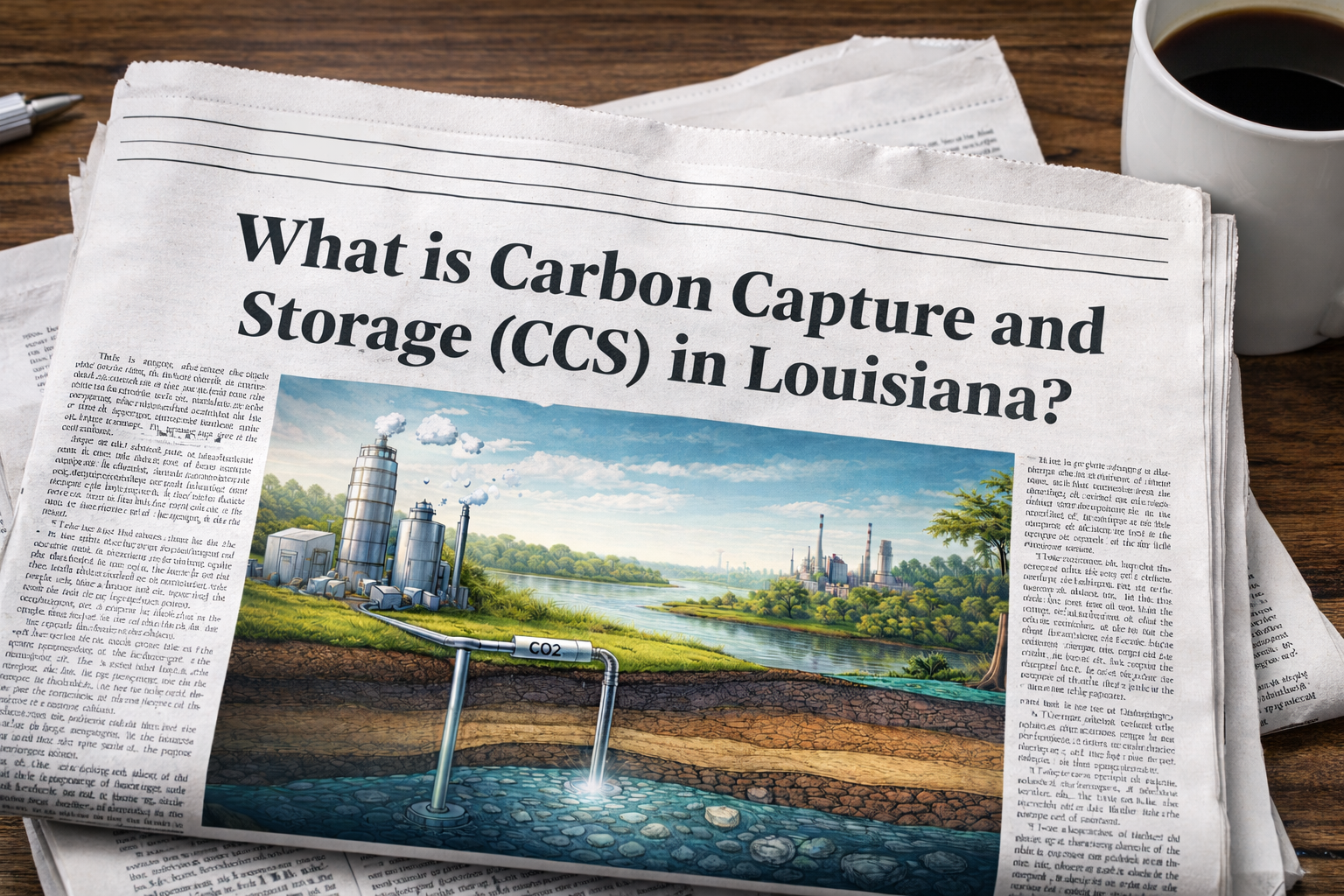
Carbon Capture and Storage is an industrial process designed to capture carbon dioxide (CO₂) produced by power plants, chemical facilities, ethanol plants, refineries, and other large industrial sources, and then transport and inject that CO₂ deep underground for long-term storage.
The CCS process generally involves three steps:
- Capture – CO₂ is separated from other gases produced during industrial operations.
- Transport – The compressed CO₂ is moved—most often by pipeline—to an injection site.
- Storage – The CO₂ is injected thousands of feet underground into geological formations, where it is intended to remain contained.
The stated goal of CCS is to reduce carbon emissions entering the atmosphere. But the scale, risk, and long-term accountability of widespread CCS expansion remains heavily debated.
Why Louisiana Is at the Center of CCS Expansion
Louisiana has become one of the primary targets for CCS development in the United States for several reasons:
- Extensive underground geology long associated with oil and gas development
- Dense pipeline infrastructure and industrial corridors
- A regulatory environment shaped by decades of energy permitting
- State policies that have encouraged large-scale CCS activity
- Federal incentives that reward carbon capture and storage
As a result, Louisiana now faces dozens of proposed CCS projects, expanding pipeline plans, and a growing number of injection well applications.
In many cases, CO₂ captured outside Louisiana is planned to be transported into Louisiana for storage—making the state a national hub for sequestration activity.
How CCS Works Underground
Once injected, CO₂ is stored in deep geological formations such as saline aquifers or depleted oil and gas reservoirs—often more than a mile below the surface.
Supporters argue these formations can safely contain CO₂ long-term. Critics point to unresolved concerns:
- Potential migration through faults or fractures
- Risk pathways through old or abandoned wells
- Impacts to underground drinking water sources if containment fails
- Monitoring and enforcement challenges over decades
- The question of long-term liability and who pays if something goes wrong
Unlike most industrial projects, CCS requires confidence not just for years—but for generations.
Property Rights and Eminent Domain Concerns
One of the most controversial aspects of CCS in Louisiana involves property rights.
To build pipeline networks and storage infrastructure, companies often need easements and long-term access to private land. Landowners have raised concerns about pressure tactics, limited disclosure, and the potential use of eminent domain—especially when pipeline routes are treated as serving a “public purpose.”
This raises fundamental questions:
- Who owns the underground “pore space” where CO₂ is stored?
- Can land be taken for privately owned CO₂ pipeline projects?
- What rights do surface owners retain?
- What happens if a landowner refuses to sign?
These issues are now central to legislative debates and legal strategies across the state.
Oversight and Public Transparency
CCS is regulated through overlapping state and federal frameworks involving environmental protection, natural resources, and injection well oversight.
Concerns commonly raised by residents include:
- Public notices that are hard to find or interpret
- Technical documents that are difficult for ordinary citizens to evaluate
- Long-term enforcement that depends on sustained regulatory capacity
- Communities learning about projects late in the process
Supporters argue CCS is heavily regulated and essential for national climate goals. Opponents argue the burden of proof should be higher when projects affect land rights and water security.
The Role of the Louisiana CO₂ Alliance
As CCS projects expanded, grassroots resistance and public education efforts grew.
The Louisiana CO₂ Alliance has been on the front lines of this fight—building momentum across parishes and helping everyday Louisianans understand what’s happening beneath their feet and behind closed doors.
The Alliance has worked to:
- Educate residents on proposed carbon capture and storage (CCS) projects and what they could mean for landowners, families, and local communities
- Support parish-level organizing, including resolutions and coordinated local action that gives citizens a stronger voice at the table
- Raise serious concerns about subsurface risk, abandoned wells, and the long-term protection of Louisiana’s water resources
- Advocate for real legislative reform that defends landowner rights, restores local control, and puts transparency back into a process that has moved too fast for public accountability
Why CCS Has Become So Polarizing
At its core, the CCS conflict in Louisiana reflects larger questions:
- Who benefits economically from CCS?
- Who bears the long-term risk?
- How much authority should state government have over local decisions?
- Who is accountable 30–50 years from now?
For some, CCS represents innovation and investment. For others, it feels like an industrial experiment placed on rural communities without meaningful consent.
Why Understanding CCS Matters Now
CCS is not theoretical in Louisiana. Permits are being pursued. Infrastructure is being planned. Lawsuits and legislative proposals continue shaping how CCS will unfold over decades.
Whether one supports or opposes CCS, informed public participation is essential. Understanding the basics is the first step.
CCS Glossary: Key Terms Louisiana Residents Should Know
Carbon Capture and Storage (CCS) — Capturing CO₂ from industrial facilities and injecting it underground for long-term storage.
Carbon Dioxide (CO₂) — A gas that can be hazardous in high concentrations because it displaces oxygen.
Sequestration — Permanent underground storage of CO₂.
Class VI Injection Well — A well type specifically regulated for long-term CO₂ storage.
Class V Injection Well — A broader well category sometimes used for pilot or experimental injection activities.
Pore Space — Underground voids where CO₂ is stored; ownership is a major legal issue.
Eminent Domain — The government’s power to take private property for public use with compensation; controversial for pipelines.
CO₂ Pipeline — Pipeline designed to transport compressed CO₂ from capture to injection sites.
Saline Aquifer — Deep rock formation containing saltwater; frequently targeted for storage.
Abandoned Well — An old well that may create a leakage pathway depending on condition.
45Q Tax Credit — Federal incentive paid per ton of CO₂ captured and stored.
Frequently Asked Questions About CCS in Louisiana
Is carbon capture and storage currently happening in Louisiana?
Yes. Louisiana has proposed, permitted, and operational CCS activity, including planned CO₂ pipelines and injection wells.
Why is Louisiana being targeted for CCS?
Louisiana has extensive geology, heavy industry, and infrastructure that make large-scale CCS attractive to developers.
Can CO₂ leak after it is injected underground?
This is debated. Concerns include faults, fractures, and abandoned wells that could provide migration pathways.
Does CCS affect drinking water?
Critics warn that CO₂ migration could threaten underground sources of drinking water over long timeframes if containment fails.
Can eminent domain be used for CCS pipelines?
In some cases, companies may seek eminent domain authority for pipeline construction, which is a major point of dispute.
Who is responsible if something goes wrong decades later?
Long-term liability is one of the biggest unresolved issues. The key question is whether future responsibility shifts to the state and taxpayers.
Editorial Note
This explainer is part of CO₂ Chronicles’ ongoing coverage of carbon capture policy, land rights, and environmental governance in Louisiana.

