
The Last Drop: Louisiana’s Gamble with the Chicot Aquifer
Part 1: The Water We Cannot Lose
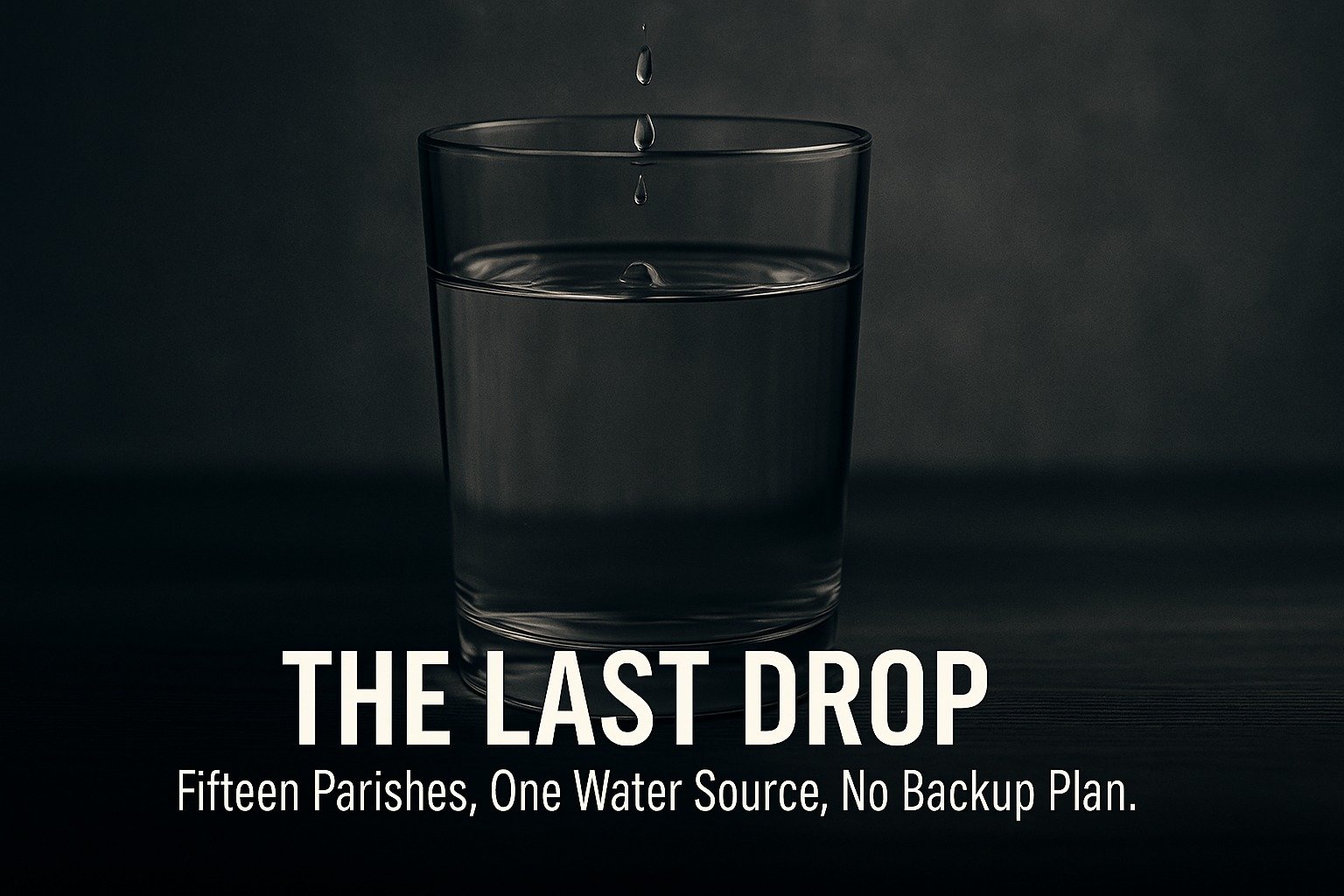
A glass of water sits on the kitchen table in Acadiana. Clear, cool, and taken for granted. It is the same water filling baby bottles, school water fountains, and the boiling pots of gumbo in fifteen Louisiana parishes. That glass comes from the Chicot Aquifer — the sole source of drinking water for more than half a million people in southwest Louisiana.
There is no Plan B. No backup river. No secondary aquifer. EPA has classified the Chicot as a sole-source aquifer. If Chicot falls, southwest Louisiana falls.
Life Without the Chicot
Imagine waking up tomorrow and discovering that the water from your tap — the only water your parish has ever relied on — is no longer safe.
- Schools are forced to shut their fountains and haul in bottled water for children.
- Hospitals scramble for tanker trucks to keep dialysis machines running.
- Farmers stare at cracked rice paddies, their irrigation wells poisoned.
- Families line up in parking lots for cases of bottled water, unsure how long they can stay in their own homes.
Now stretch that scene beyond a week of bottled water. Imagine it forever.
The Financial Fallout (First Ripples)
The collapse of the Chicot Aquifer wouldn’t just poison water. It would poison the economy.
- Home values across fifteen parishes would plummet. A house with no safe water is unsellable.
- Small businesses — from restaurants to crawfish farms — would shut their doors overnight.
- Parish governments would face bankruptcy trying to keep residents hydrated and businesses afloat.
Experts who’ve studied similar disasters in Flint, Michigan and Bayou Corne, Louisiana know the truth: a poisoned water source is not a temporary inconvenience — it is a generational catastrophe.
The Clock is Ticking
Based on what we uncovered in our last exposé, Cracks in the Promise, this is not a question of if. It is a question of when. The science is clear: once CO₂ and carbonic acid seep into groundwater, metals and toxins are released. Wells that have been clean for a century can turn toxic overnight.
USGS data already shows dissolved solids and salinity creeping into wells across the aquifer. The only uncertainty is how long it takes before the water is undrinkable.
The Most Chilling Part
Louisiana’s leaders already know what this would mean. And instead of protecting the public, they wrote the fine print that leaves you holding the bill.
As the Louisiana Illuminator recently reported, communities sitting above the Chicot Aquifer are raising the alarm about carbon capture projects that could endanger the very water keeping them alive.
But what most people don’t yet realize is just how big the price tag really is — and who engineered the deal to leave Louisiana citizens paying it.
The Last Drop: Louisiana’s Gamble with the Chicot Aquifer
Part 2: The Price Tag of Poison
(Free Weekend Edition)
A Catastrophe Waiting to Be Priced
Water is life. But in Louisiana, the Chicot Aquifer isn’t just life — it’s the only life support system for fifteen parishes. Every glass of water, every pot of rice, every crawfish pond in southwest Louisiana depends on this underground reservoir.
If it fails, the loss can’t be measured in gallons. It has to be measured in billions of dollars — and generations of damage.
State leaders have capped corporate responsibility for CCS accidents at just $10 million per company. Yet history shows that when water is poisoned, the costs climb into the billions, and recovery — if it ever comes — can take decades.
The Real Costs, Line by Line
- Bottled Water Distribution
Half a million people depend on the Chicot.
At one gallon per person per day, that’s 500,000 gallons daily.
At roughly $1.50 per gallon wholesale, that’s $750,000 a day — $273 million a year.
And that doesn’t include trucking, storage, or distribution centers. - Trucking & Tanker Deliveries
FEMA estimates that hauling emergency water can cost 10–20 times more than a bottled retail supply.
Just transportation alone could add another $150 million per year. - Emergency Infrastructure
Replacing the Chicot means new water pipelines — and new treatment plants.
A single 30-mile municipal pipeline costs $100–250 million.
To reach fifteen parishes? Expect $1–2 billion before the first drop flows. - Groundwater Remediation Attempts
“Pump and treat” systems for localized contamination cost $1–10 million per site.
For a region-wide aquifer, scientists admit remediation is nearly impossible.
Even partial containment could cost hundreds of millions — and still fail. - Lost Agriculture
The rice industry alone depends on the Chicot.
Louisiana rice production generates approximately $1.8 billion annually.
Without clean irrigation, that vanishes overnight. Crawfish, cattle, and sugarcane wouldn’t be far behind. - Public Health Costs
Once CO₂ or its byproducts infiltrate groundwater, it can mobilize arsenic, lead, and uranium — all linked to cancers, neurological disorders, and kidney disease.
Treating those illnesses would cost tens of millions annually, and that doesn’t begin to account for the human cost.
Case Studies: Lessons Written in Poison
Louisiana doesn’t have to imagine what happens when the water turns bad — the nation already has examples written in pain and lawsuits.
- Flint, Michigan (2014–present):
- $1.5 billion in recovery and legal costs — and counting.
- Only 100,000 people were affected. The Chicot serves five times that.
- Bayou Corne Sinkhole (2012):
- $1 billion in cleanup, buyouts, and lawsuits.
- A community of just a few hundred people was displaced and gone forever.
- Satartia, Mississippi Pipeline Rupture (2020):
- Dozens were hospitalized after a CO₂ pipeline leak suffocated the town.
- Cleanup and penalties in the millions.
- And that was just one leak — not an entire aquifer.
The Liability Mirage
Louisiana law currently requires CCS operators to post:
- $5 million per well site.
- $10 million maximum cap per company.
That’s it. Ten million dollars to cover a potential multi-billion-dollar disaster.
And thanks to SB 244 and Act 378 of 2023, once a site is “certified closed,” the state holds itself harmless. The company walks away. The public is left with the bill.
It’s not hypothetical. It’s the law. Corporations keep the profits, citizens inherit the poison.
The Price Louisiana Can’t Pay
Let’s run the numbers conservatively:
- Bottled water: $273 million
- Trucking/logistics: $150 million
- Emergency infrastructure: $1.5 billion
- Agriculture collapse: $1 billion
- Health care costs: $50 million annually
- Lawsuits and damages: $500 million+
Total first-year fallout: $3.5–4 billion.
That’s 400 times higher than the maximum corporate liability.
Lake Chicot: The Heart of the Story
At the center of this looming crisis lies Lake Chicot, a natural treasure that feeds the aquifer itself — and the people, crops, and ecosystems that depend on it. Once contamination begins, it spreads like a bruise beneath the soil.
Farmers can’t irrigate. Families can’t drink. Businesses can’t operate. Parishes can’t recover.
And there is no replacement. There is no Plan B.
The Reality Check
The Chicot Aquifer cannot be replaced — not at any price.
The math proves it. The science confirms it. And the state knows it.
Yet Louisiana’s leaders have written laws to protect corporations instead of citizens, shifting the risk from boardrooms to backyards.
And while the public pays the price, the very companies behind CCS projects cash in on federal tax credits meant to “fight climate change.”
It’s the perfect scam — until you turn on your tap and nothing safe comes out.
Take Action Now
The future of the Chicot Aquifer — and every family that depends on it — is on the line.
Save My Louisiana is preparing to file a lawsuit to challenge the policies and projects threatening our only water source. Their team of citizens, legal experts, and advocates is taking a stand where state officials won’t.
🌐 Learn more and support the cause: SaveMyLouisiana.org
Because protecting Louisiana’s water isn’t just an environmental issue — it’s survival.

