

Eminent Domain Didn’t Start With CCS — And It Didn’t Start in 2020
Why Louisiana’s 2026 Debate Requires Looking Back to 1981
As Louisiana approaches the 2026 legislative session, debate over carbon capture and sequestration (CCS) and eminent domain is often framed as a recent controversy—one created by Act 61 of 2020.
That framing is incomplete.
The legal authority allowing private companies to acquire land for carbon dioxide pipelines and underground injection did not originate with modern climate policy. It did not begin in 2009. And it did not begin in 2020.
It began in 1981.
Understanding that history is essential for evaluating whether proposed reforms in 2026 will meaningfully restore property rights, or merely adjust how existing authority is exercised.
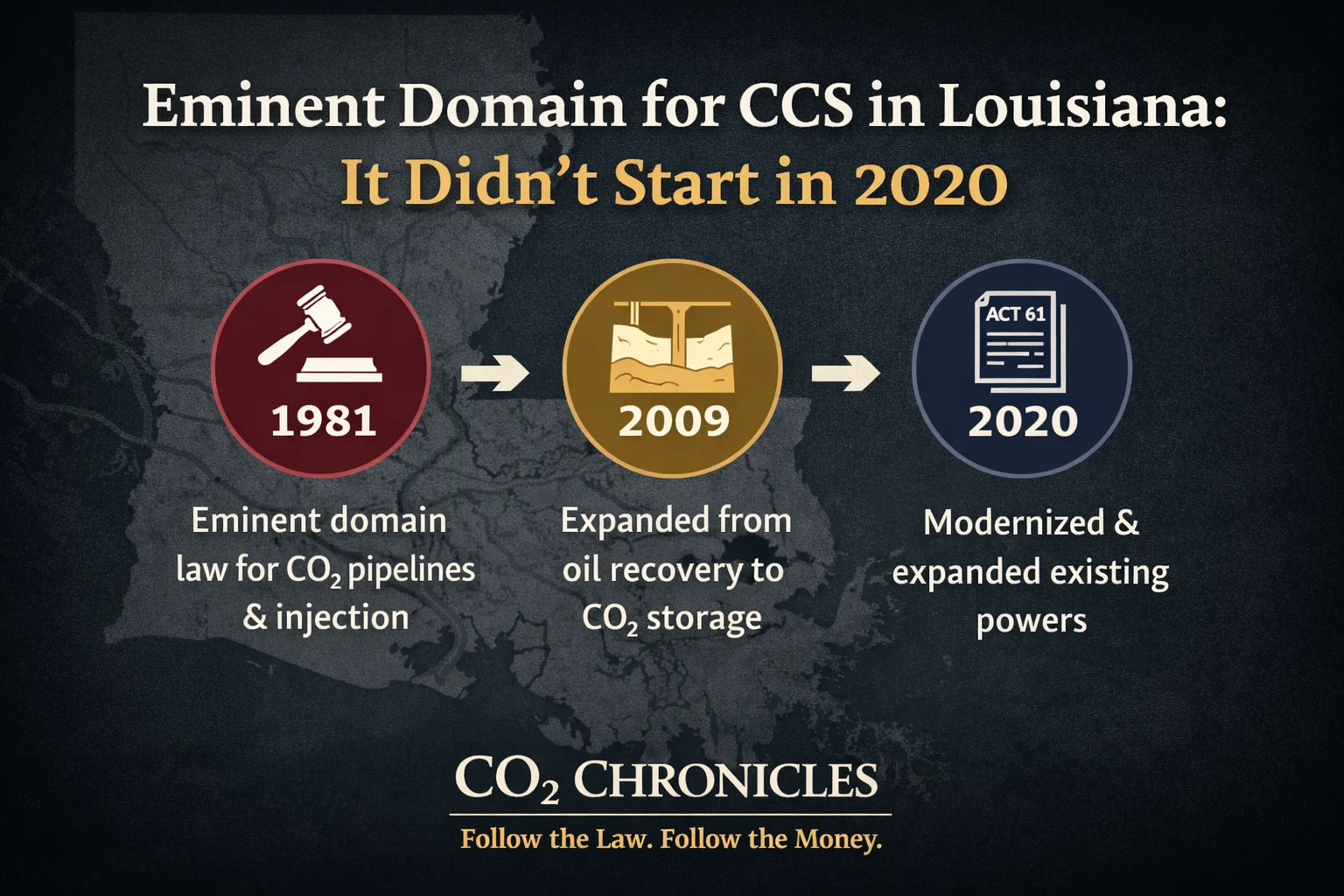
1981: The Origin of CO₂ Eminent Domain in Louisiana
In 1981, the Louisiana Legislature passed Act 760, amending the state’s eminent domain statutes to authorize private domestic and foreign corporations engaged in the transportation of carbon dioxide for underground injection to expropriate land, subject to approval by the Commissioner of Conservation.
At the time, this authority was intended to support oil and gas operations, particularly enhanced oil recovery, not environmental or climate-driven projects. Carbon dioxide was treated as an industrial commodity, not a pollutant.
Legally, however, the purpose was secondary.
Act 760 established three principles that still shape Louisiana law today:
- Private companies could use eminent domain for CO₂ pipelines
- Underground injection of CO₂ qualified as a public-purpose activity
- State agency approval—not landowner consent—determined necessity
This framework became the legal foundation for every CCS statute that followed.
2009: Expansion From Oil Recovery to Carbon Storage
In 2009, Louisiana enacted the Geologic Sequestration of Carbon Dioxide Act, expanding the use of underground CO₂ injection from oil recovery to long-term storage.
This law:
- Authorized permanent geological storage of carbon dioxide
- Created a regulatory structure for sequestration reservoirs
- Extended eminent domain authority to include subsurface pore space
Crucially, the 2009 statute did not repeal or replace the 1981 authorization. Instead, it expanded the scope of activities governed by it.
By 2009, Louisiana law clearly allowed private entities to transport carbon dioxide, inject it underground, and acquire surface and subsurface rights through expropriation—provided the project received state approval.
2020: Act 61 Clarified Existing Power — It Did Not Create It
Act 61 of 2020 is often described as the moment when CCS eminent domain was created. In reality, Act 61 clarified and modernized authority that already existed.
The Act:
- Reaffirmed eminent domain powers for CCS infrastructure
- Updated definitions to reflect modern sequestration projects
- Integrated CCS into existing regulatory frameworks
What Act 61 did not do was originate the power to take land for CO₂ pipelines or underground injection. That authority was already embedded in Louisiana law—first granted in 1981 and expanded in 2009.
The difference in 2020 was scale and visibility. Federal incentives and large, multi-parish projects brought renewed public attention to authorities that had existed for decades.
🔎 Why the 1981 Law Still Matters
Claims that the 1981 statute is irrelevant because it did not use the modern term “CCS” misunderstand how law operates. Statutes govern activities and authority, not later terminology. In 1981, Louisiana law explicitly authorized private companies to use eminent domain for carbon dioxide pipelines and underground injection—the same core activities that define today’s CCS projects. Later laws expanded and clarified that authority; they did not create it.
Recent Reforms Adjusted Process — Not Authority
Legislative changes in recent sessions focused on:
- Unitization thresholds
- Notice and hearing requirements
- Safety and monitoring provisions
While these measures altered how CCS projects are reviewed and implemented, they did not eliminate eminent domain authority. The underlying legal framework—rooted in 1981—remained intact.
HB 7 and the 2026 Legislative Test
In the 2026 session, Mike Johnson is expected to introduce HB 7, a bill described as an effort to end CCS-related eminent domain in Louisiana.
Unlike prior reforms, HB 7 is intended to remove the authority itself rather than modify procedures. Whether it succeeds will depend on statutory precision, including:
- Whether it overrides the original 1981 authorization
- Which statutes are explicitly repealed
- Whether CCS projects could still qualify under other eminent domain provisions
In statutory law, outcomes depend on language—not intent.
What Citizens Should Ask Legislators in 2026
As this debate unfolds, informed engagement requires specific questions:
- Does the bill repeal CCS eminent domain back to 1981?
- Which statutes are repealed by number?
- Can CO₂ infrastructure still qualify under other eminent domain laws?
- Who determines whether a project serves a public purpose?
- Does landowner consent replace administrative approval?
- How are existing permits and applications treated?
Clear answers matter more than broad assurances. We welcome any other questions you feel were left off the list. journalist@co2chronicles.com
Editorial Note to Readers
Louisiana’s CCS eminent domain framework was not created overnight. It evolved quietly over decades—beginning in 1981, expanding in 2009, and clarified in 2020.
Meaningful reform in 2026 will require addressing that entire legal chain, not just its most recent expression.
CO₂ Chronicles will continue tracking this issue through the legislative session, focusing on statutory language, amendments, and enforcement—so readers can evaluate proposals based on law and history, not assumptions.

