

The Quiet Foundation – How CCS Crept Into Louisiana Law – Part 1
From Jindal to the Present: Laying the Legal Groundwork for Carbon Capture and Sequestration
In Louisiana, where oil and gas are part of the cultural fabric, few expected that a complex industrial process like carbon capture and sequestration (CCS) would reshape the political landscape. Yet, the foundation for Louisiana’s current CCS surge didn’t begin with Governor John Bel Edwards or the controversial SB353. It began much earlier—under Governor Bobby Jindal in 2008 and 2009—with legislation that quietly rewrote how carbon dioxide (CO₂) is treated under the law.
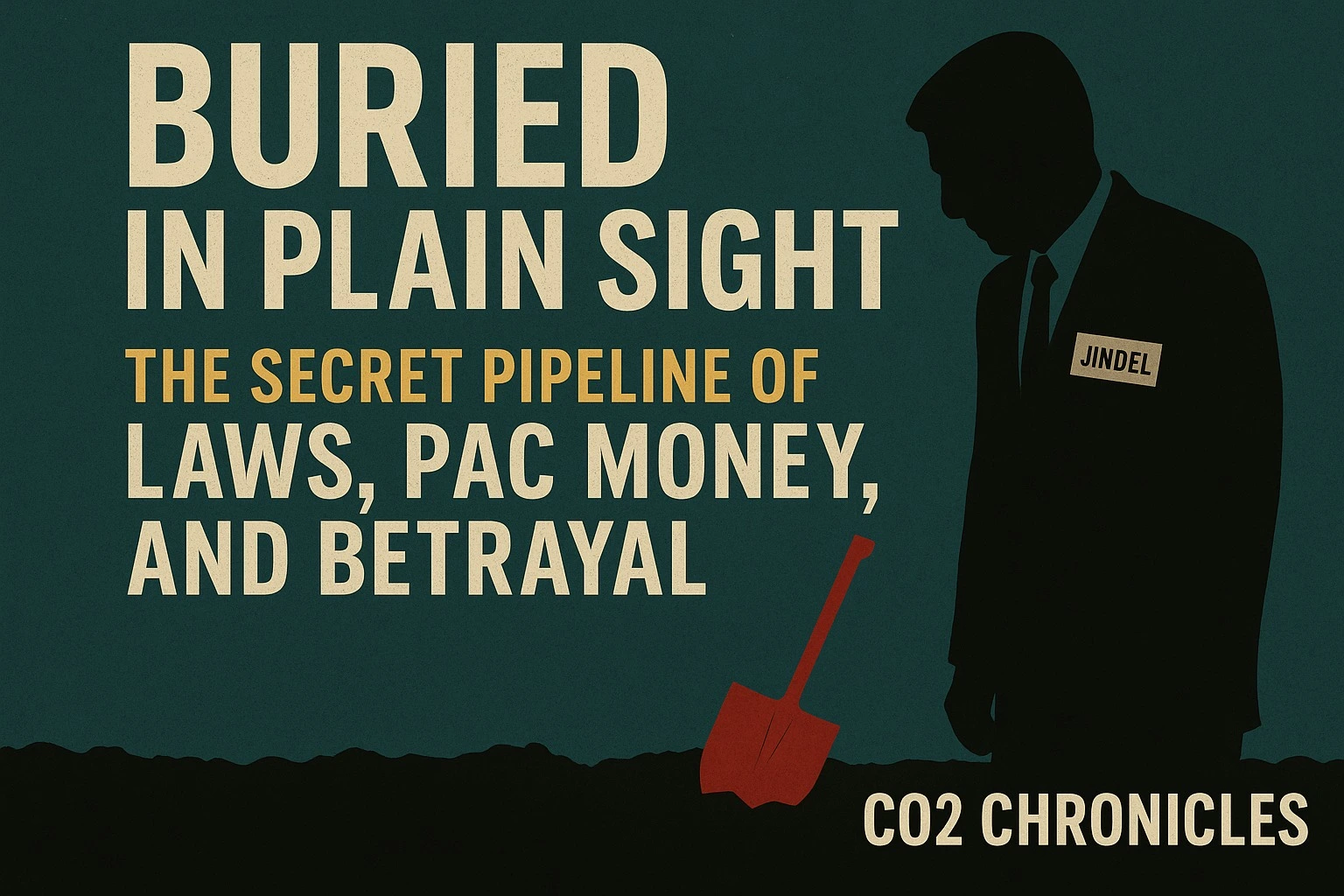
This first installment of “Buried in Plain Sight: The Secret Pipeline of Laws, PAC Money, and Betrayal” dives into the origin story—the policy roots of CCS in Louisiana. Understanding this timeline is critical before we follow the money trail and name the players behind the push to industrialize large swaths of the state.
The Timeline: How It All Started
2008 – Declaring CO₂ Storage a “Public Purpose”
Governor Bobby Jindal signed Act 315 (HB1117), a pivotal piece of legislation that designated the underground storage of carbon dioxide as being in the public interest. This law allowed the state to lease depleted oil and gas reservoirs for CO₂ storage and declared that CO₂ would remain the property of the injector, not the surface or mineral owner. Eminent domain powers were quietly extended to carbon storage infrastructure—setting the legal precedent for future land disputes.
Key takeaway: This law redefined CO₂ as a “valuable commodity” for industrial use, including Enhanced Oil Recovery (EOR).
2009 – The CCS Legal Framework Is Cemented
In the following year, House Bill 661, authored by State Rep. Jim Morris, became Act 517, Louisiana’s first comprehensive Geologic Sequestration of Carbon Dioxide Act. Signed into law by Jindal in July 2009, it created:
- A regulatory framework for permitting CCS wells.
- A “Certificate of Public Convenience and Necessity” process for pipelines.
- A Geologic Storage Trust Fund to manage long-term liability.
- The legal transfer of ownership and liability to the state 10 years after injection ends.
- Reinforcement of eminent domain powers for pipeline construction.
Brett Geymann, now the Chair of Louisiana’s Natural Resources Committee, voted in favor of this bill as a legislator in 2009—marking his early alignment with CCS-friendly policies.
The Players at the Start
Gov. Bobby Jindal – Signed both Acts 315 and 517 into law, opening the door to CCS in Louisiana.
Rep. Jim Morris – Sponsored HB661 and later became a lobbyist at the Louisiana Mid-Continent Oil & Gas Association (LMOGA) after leaving office.
Brett Geymann – Voted for HB661; now chairs the Natural Resources Committee overseeing CCS matters.
Tyler Gray – Worked in Louisiana government during the early CCS discussions, later helped draft SB353 (2020) and SB244, and was recently hired by LSU for a reported $300,000/year CCS-related role.
Louisiana Department of Natural Resources (DNR) – The Office of Conservation, within DNR, became the lead agency issuing CCS permits.
Denbury Inc. – A CO₂-EOR company already developing pipeline infrastructure in 2009; later became a major author of SB353.
Key Provisions Set by 2009
- CO₂ as Property of the Injector: Louisiana law now unambiguously states that once CO₂ is captured and injected, it remains the injector’s property and cannot be claimed by surface or mineral rights owners la.gov. This meant a CO₂ pipeline developer (typically an oil company) would own the gas long after it was underground.
- CO₂ for Enhanced Oil Recovery: The statutes frame CO₂ storage as a tool for the oil industry. Act 517’s policy section notes that CO₂ “may be available for … uses, including the use of carbon dioxide for enhanced recovery of oil and gas. In practice this encouraged oil companies (like Denbury) to buy or pipeline CO₂ from industrial plants into aging oil fields.
- Eminent Domain & Pipeline Rights: By 2009 the law allowed CCS projects to use eminent domain to secure pipeline routes and site leases. However, injection wells themselves were still subject to public hearing approval by the Commissioner. The new laws explicitly gave the state (or its lessees) the power to use eminent domain for “geologic sequestration” facilities betterenergy.org.
- State Oversight & Liability: The Office of Conservation gained broad jurisdiction over CCS. Operators must comply with Safe Drinking Water Act rules (Class VI wells) but under state authority. The 2009 Act created a regulatory scheme: operators pay fees into the Trust Fund, the Commissioner issues permits, conducts inspections, and after injection stops the project must be monitored for 10 years. After that period, the injected CO₂ ownership and liability pass to the state carboncaptureread
The Federal Influence
The timing of Louisiana’s legislation wasn’t coincidental. The federal government, under President Obama, began ramping up support for CCS as part of climate and energy policy:
- In 2009, the Department of Energy (DOE) launched site characterization and demonstration funding for CCS projects, including those in Louisiana.
- The Southern States Energy Board and the SECARB partnership promoted “model” CCS policies and provided technical guidance to states like Louisiana.
- S. Federal Officials: In D.C., DOE Secretary Steven Chu and EPA Administrator Lisa Jackson (both appointed in 2009) oversaw federal CCS policy. DOE’s fossil energy team funded Louisiana projects and had monthly working groups with the states on Class VI permitting. On Capitol Hill, members of Congress from Louisiana (Senators Mary Landrieu and David Vitter, plus Representatives such as Bill Cassidy and Rodney Alexander) supported energy and climate R&D funding. Federal regulatory agencies began planning how (or whether) to cede CO₂ permitting to the state under the Safe Drinking Water Act (an issue that would later surface in Louisiana).
These incentives and funding flows set the stage for what would become a CCS pipeline not just under the ground—but across state capitols, boardrooms, and PAC accounts.
Understanding the Strategy
It’s easy to assume CCS emerged overnight. In reality, the system was engineered over 16 years, starting with small, quiet legal changes and escalating into a well-funded, multi-layered policy scheme. These laws:
- Preempted public resistance by defining CO₂ as state-controlled property.
- Enabled private gain by granting eminent domain and public funding for industrial projects.
- Shifted future risk to taxpayers through liability transfer after 10 years.
🔜 Coming Next in the Exposé:
Part 2 – “The Edwards Era”
We’ll examine how SB353 (2020) and its successor SB244 supercharged the CCS industry, naming the legislators, lobbyists, and PAC dollars that helped it pass. You’ll see how private entities helped draft public law—and how millions were funneled into political coffers.
Part 3 – The Landry Machine
We’ll expose the current players, reveal the contracts and consultants, and follow the money into 2023-2024. You’ll also learn how the citizen-led lawsuit by Save My Louisiana could be the first major obstacle in halting this land grab.
📣 Subscribe for $1 to Read the Full Exposé Series
To continue reading Buried in Plain Sight, subscribe to CO₂ Chronicles for just $1 for a 3-month trial. This small contribution helps protect our site from bots and lets us continue publishing fearless investigative journalism.
👉 Use this link to subscribe for $1 Click here to subscribe now
Long live free speech. Long live transparency.

